on
The Rise of the Product Development Engineer
You open your IDE. Before you finish typing the function signature, your AI assistant has already written the implementation. It is correct. It passes the tests. It even follows your team’s naming conventions. You review it, approve it, and move on.
Now ask yourself: if an AI can write that function faster and more consistently than you, what exactly is your job?
The answer is not that software engineering dies. The answer is that it evolves. The craft expands beyond code. The engineers who will thrive in this era are not the ones who write the fastest functions — they are the ones who know which functions should be written in the first place, why they matter, and how they connect to the business and the customer. I call this role the Product Development Engineer.
The Shift: Why Pure Coding Is No Longer Enough
AI has raised the floor of coding ability dramatically. Writing boilerplate, translating requirements into functions, fixing bugs from stack traces — these are increasingly AI territory. The mechanical parts of coding are no longer a differentiator.
But here is what AI cannot do: decide what to build. Understand why a customer is frustrated. Make trade-off decisions that balance technical debt against time-to-market. Anticipate how an architecture choice today will constrain the product two years from now. These are human judgment calls — and they are becoming the most valuable skills an engineer can have.
When calculators arrived, mathematicians did not disappear. The job of doing arithmetic got automated. The job of understanding what to calculate and why became more valuable. Software engineering is going through the same transition.

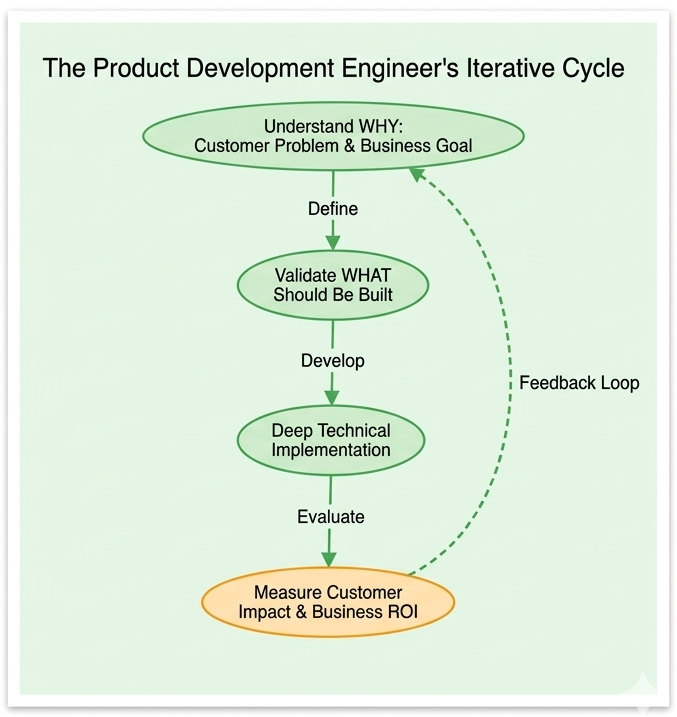
Most engineering career ladders are still built around “can you write good code?” But the teams that win are the ones where engineers also understand “should we write this code at all?”
The New Role: Product Development Engineer
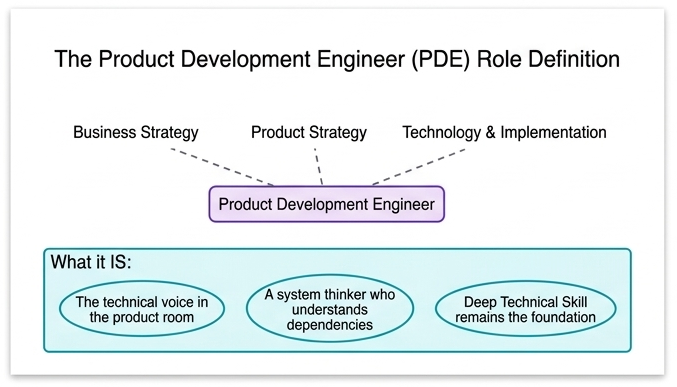
A Product Development Engineer is an engineer who retains deep technical skill but layers on the ability to think about business objectives, product strategy, and customer experience. They do not replace product managers, designers, or business leaders — they complement them by bringing a technical mind that also speaks those languages.
What it is NOT:
- Not a “full-stack developer” — that is frontend plus backend, still a purely technical scope
- Not a product manager who can code — the primary identity is still engineer
- Not a generalist who does everything poorly — deep technical skill remains the foundation
What it IS:
The Product Development Engineer sits at the intersection of Business, Product, and Technology
The Framework: Eight Pillars
Here is a framework for growing beyond code. These are not a checklist — they are growth dimensions to develop deliberately over time. Start with the one that feels most uncomfortable.
1. See the Full Stack (Business → Product → Tech). Every feature should trace back to a business objective and forward to customer impact. Most engineers see a ticket. A PDE sees the chain: business goal → product decision → technical implementation → customer outcome.
2. Wear Multiple Hats. Practice thinking as Product (“What problem are we solving?”), UX (“What is the experience?”), Business (“What is the ROI?”), and Tech (“How do we build it right?”). Not replacing specialists — developing empathy across domains.
3. Define “Done” Beyond Code. A feature is not done when the PR merges. It is done when it solves the customer’s problem. Write acceptance criteria that include customer impact, not just “tests pass.”
4. Start from Customer Problems. “We need microservices” is a solution. “Customers experience 3-second latency on search” is a problem. Start from problems. Internal ideas are hypotheses. Customer problems are data.
5. Think in Systems, Not Tickets. Understand the dependencies between your work and others’. A database choice affects latency, cost, and customer experience. Your blocker might be blocking three other people’s work downstream.
6. Know When to Decide, When to Escalate. Consider the blast radius. Renaming a variable? Just decide. Choosing a database technology? Bring people in. Develop calibration for when a decision is a $5 bet versus a $50,000 bet.
7. Communicate in Business Language. “We should use PostgreSQL over MongoDB” means nothing to a CEO. “This choice saves $200/month and makes search 10x faster” does. Lead with impact, not implementation.
8. Build Deep Domain Knowledge. A great PDE in healthcare knows HIPAA constraints without being told. Domain knowledge is what makes generic decisions sharp. It compounds over time and is the hardest pillar to shortcut.
I explore each pillar in depth — with practical exercises and examples — in Eight Pillars of a Product Development Engineer.
Getting Started: What You Can Do This Week
-
Trace one feature. Write down the chain from business goal to code to customer impact. If you cannot fill in a step, go find out.
-
Read 10 customer reviews. Go to your product’s feedback channel. Note one technical implication you had not considered.
-
Rewrite one technical decision in business language. Three sentences a non-technical executive could understand.
-
Map one dependency chain. Who are you blocking? Who is blocking you? What happens if you are late?
-
Ask “why?” one more time. Next time you receive a requirement, ask one more “why?” to understand the business context.
What Comes Next
This framework is not only for engineers. Product managers, designers, and business leaders also benefit from expanding their peripheral vision into adjacent domains. A future post will explore what the equivalent growth framework looks like for non-engineers — how someone without a coding background can develop the technical literacy and systems thinking to become a Product Development Engineer from the other direction.
The AI era does not eliminate roles. It pressures every role to expand beyond its narrow lane. The engineers who thrive will be the ones who see this as an opportunity, not a threat.
The best engineers have always been Product Development Engineers. They just did not have a name for it. Now, it is not optional. It is the expectation.
- Inspired by Marty Cagan — The definitive guide to product thinking for people who build technology products
- The Pragmatic Programmer by David Thomas and Andrew Hunt — The original argument for engineers who think beyond code
- Thinking in Systems by Donella Meadows — A primer on systems thinking that changes how you see dependencies and feedback loops
- An Elegant Puzzle by Will Larson — Engineering leadership through the lens of organizational systems
- Shape Up by Basecamp — A product development methodology that puts engineers at the center of product decisions